Skip to content
BMRDIGITAL

AI directory

Find AI Tool

AI tool discovery and directory project.

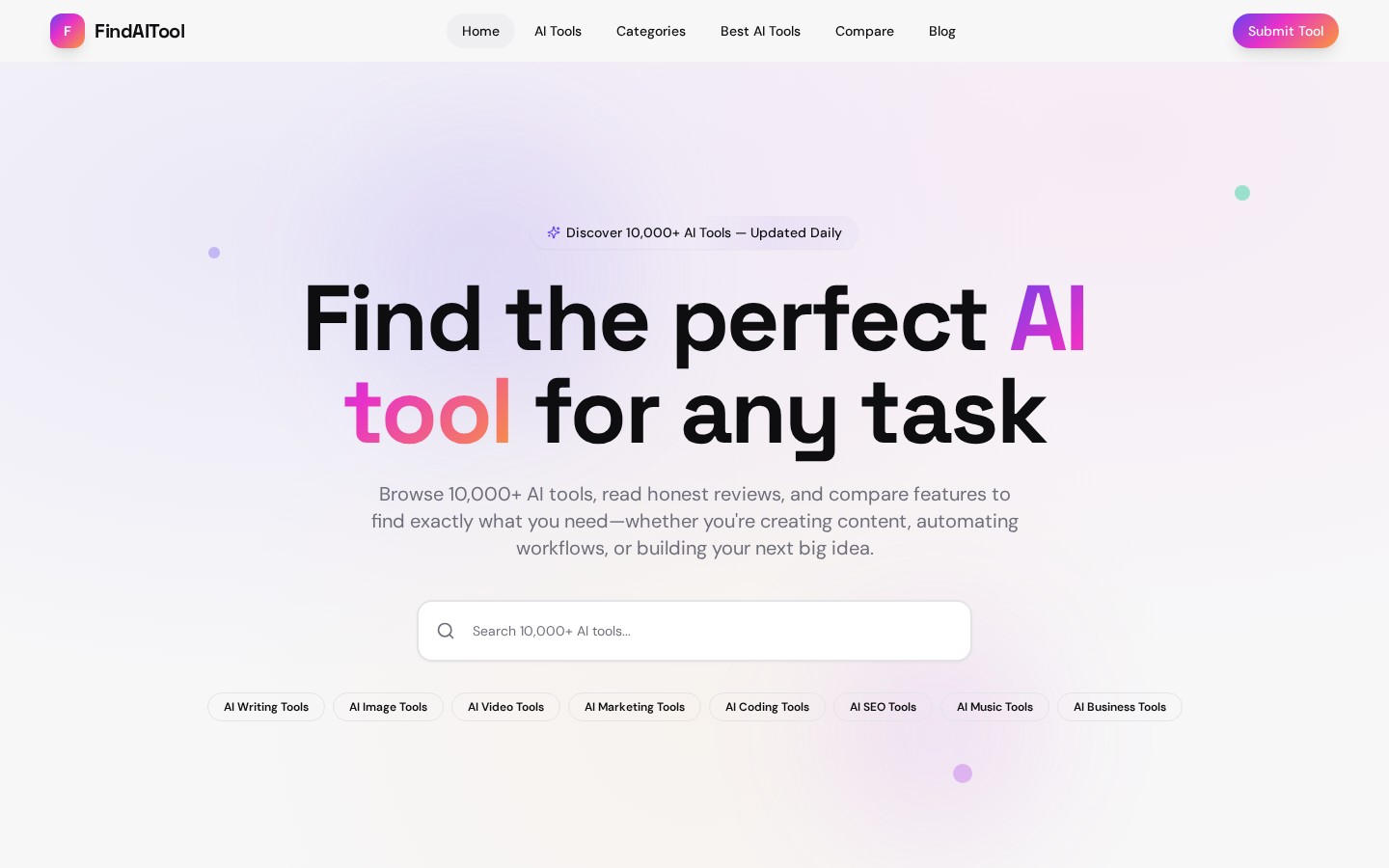
Find AI Tool directory website listing page

findaitool.com· Live screenshot

The challenge

A fast-moving category with thousands of tools, where search demand changes weekly and duplicate thin listings are the usual failure.

What we did

  • · Directory architecture with categories and filters
  • · Listing templates with unique, useful descriptions
  • · Fast search and browse experience

SEO strategy

  • · Category-led keyword mapping
  • · Unique content per listing rather than scraped blurbs
  • · Technical SEO for a large, frequently updated site

Where it stands

Ongoing directory build-out.

← Back to all work
Share

Other projects

Want this kind of work on your website?

Send us your website and we'll identify the biggest opportunities — SEO problems, speed, missed keywords and local ranking potential. No pressure, no jargon.

In more depth

The practical detail

How do you build a directory site that Google actually likes?

The biggest pitfall for any directory website, and one we knew we had to tackle head-on with Find AI Tool, is thin content. It's the number one reason they fail. Search engines like Google are smart; they see thousands of pages with just a name, a logo, and a two-line description copied from the tool's own website. They correctly identify this as low-value and unhelpful. It doesn't offer anything new to the user, so Google has little reason to rank it.

Our solution is simple in principle but hard in practice: write something unique and genuinely useful for every single listing. This takes time and effort, but it's the only way to build a resource that lasts. We treat each tool's page like a mini-article. We explain what it does in our own words, who it's for, and what problem it solves. This is paired with a clear, logical category structure. This doesn't just help users find what they need; it helps Google understand the website's authority on topics like 'AI image generation', turning a simple collection of links into a trusted resource.

What's the technical SEO for a large directory?

A site with thousands of pages can become slow and complicated very quickly. For Find AI Tool, performance and crawlability were top priorities from day one. We built it on a fast, lightweight foundation because every millisecond counts for user experience and for Google's crawlers. We also paid close attention to the internal linking. It's easy for a big site to become a tangled mess, but we enforce a strict hierarchy: the homepage links to major categories, which link to sub-categories and tool pages. Everything is logically connected, so search engine bots can find and index every page efficiently.

On top of that, we use structured data (Schema markup) on every listing. This is like adding a label to our content that tells search engines, in their own language, 'This is a piece of software, this is its name, and here is its purpose.' It helps them understand the page and can lead to better visibility in search results. The final piece is a dynamic XML sitemap. Every time we add or update a tool, the sitemap automatically updates and signals to Google that there's new content to check out. You can't manage a large, growing site without this kind of automation.

Why focus on categories instead of just individual tools?

When people look for a solution, they often don't know the name of a specific product. They search for things like 'best AI tool to write emails' or 'free AI voice generator'. These are category-level searches. If you only focus on ranking for specific tool names, you miss out on all these potential users. By creating strong, information-rich category pages, we target the actual problems people are trying to solve. The category page then acts as a central hub, providing an overview and guiding the user to a curated list of relevant tools that can do the job.

This approach also builds what SEOs call 'topical authority'. When we have a comprehensive category page on, say, 'AI Video Editing Tools', that links out to twenty different tool pages we've personally described, we are sending a powerful signal to Google that we are an authority on that subject. That authority then passes down to the individual tool pages, helping them rank better too. It's a strategy that builds a strong foundation for the whole site. It’s a more robust approach than just chasing the latest trending tool, and it's a method we apply across all our projects, from AI directories to websites for campervan hire firms.

Our approach: A mechanic's mindset for digital problems

Our founder, Robert, originally trained as a motor mechanic in Cupar, Fife, long before his 15+ years in SEO. That practical, diagnostic mindset is at the core of everything we do at BMR Digital. When a car comes into the garage making a funny noise, you don't just start bolting on new parts and hoping for the best. You listen, investigate, run diagnostics, and find the root cause of the problem. We treat websites the same way.

With the Find AI Tool project, we saw that most directories fail because of common, predictable issues: thin content, slow performance, and a poor user experience. Our job was to engineer a solution from the ground up that avoided these faults. We built the site architecture (the chassis) to be strong, scalable, and reliable. We then developed a content strategy (the engine) that was designed for long-term performance, not just a short-term boost. This systematic approach comes from years of hands-on experience, whether it's under a bonnet or in a website's back-end. It's about building something that works properly and is built to last.

Why unique content matters more than ever for directories

It's incredibly tempting to build a directory by automatically pulling the official marketing blurb for each product. It's fast, it's easy, and it populates your site in no time. It's also a guaranteed recipe for failure. Google's algorithms are specifically designed to identify and filter out this kind of duplicated, low-effort content. If your website adds no new information or perspective to the web, there is simply no reason for a search engine to rank it above the original source.

Our rule for Find AI Tool was absolute: no scraped content. A real person has to write a unique summary for every tool, or it doesn't go on the site. 'Unique and useful' isn't just about rewording things. It's about adding real value by answering the questions a user has before they click. Is this tool for a beginner or a professional? Does it have a free plan? What are its biggest limitations? What's the one thing it does better than its competitors? Answering these questions turns a simple listing into a genuinely helpful piece of advice and builds the trust needed to make a site successful.

The unique challenges of building in the AI space

The world of AI is moving at a blistering pace. A market-leading tool one month can be old news the next. This creates a significant SEO and content management challenge. You can't just build the site and walk away. Content becomes outdated very quickly, links break, and new categories emerge overnight. A project like Find AI Tool requires constant maintenance to remain relevant and useful, not unlike a performance car needing regular servicing to stay in top condition. We have to have solid processes for reviewing, updating, and discovering new tools constantly.

There's also a big irony we have to navigate. We're building a directory of AI tools, and the temptation to use AI to write the content is obvious. We use modern tools ourselves—they are a fantastic aid, especially for our founder who has dyslexia and ADHD. But we are firm on not using AI writers to generate the core listing descriptions. Google values content created for people, by people. An AI-generated summary often misses the subtle context and real-world insight a human expert provides. Our 'AI-search optimisation' service is built on this understanding: knowing how to use AI as a powerful assistant while ensuring human expertise and judgment remain at the centre of the work.

Ask A QuestionFree ReviewBook a call