Skip to content
BMRDIGITAL

IT support

IT Advise

Same-day UK computer help: remote support, expert answers and an AI diagnosis tool.

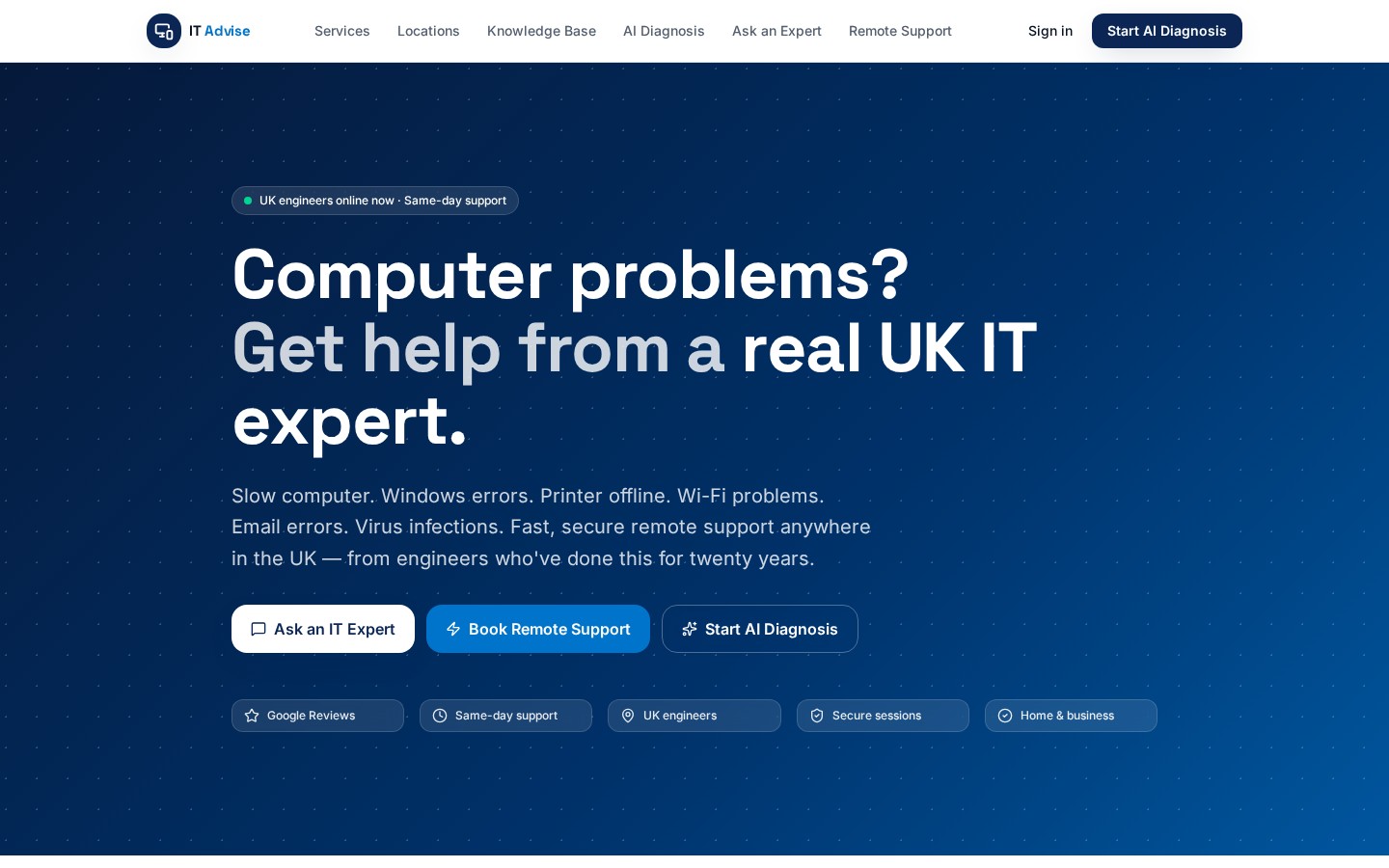
IT Advise remote IT support website homepage

itadvise.co.uk· Live screenshot

The challenge

Turning computer problems people describe in plain English into clear routes to help — remote support, a written answer from an engineer, or a free guided diagnosis.

What we did

  • · Three distinct service routes: AI diagnosis, ask an expert, book remote support
  • · A page per problem (slow computer, virus removal, Wi-Fi, Windows updates)
  • · Knowledge-base guides and location pages

SEO strategy

  • · Problem-led page structure matching how people search for computer faults
  • · Knowledge-base articles supporting the service pages
  • · Internal linking from guides to the matching fix and location pages

Where it stands

Ongoing SEO and content work.

← Back to all work
Share

Other projects

Want this kind of work on your website?

Send us your website and we'll identify the biggest opportunities — SEO problems, speed, missed keywords and local ranking potential. No pressure, no jargon.

In more depth

The practical detail

Why offer three different ways to get help?

When someone has a computer problem, they're usually stressed and short on time. The last thing they need is to be forced down a single path that might not suit them. Our first job was to map out what different people actually want in that moment. Some people are confident they just need an expert to get on with it, so 'Book Remote Support' is for them. It's direct and gets the job done.

Others aren't sure what the problem is, or if it's something they can fix themselves. They don't want to commit to paying someone yet. For them, the 'AI Diagnosis' tool acts as a free triage system, guiding them through questions to narrow down the issue. It's about providing value upfront.

Then there's the middle ground. People who have an idea what's wrong but want a human opinion before spending money. The 'Ask an Expert' option serves this need. It lets them describe the issue in their own words and get a written answer from a real engineer. By providing these three distinct routes, we cater for different levels of urgency, technical confidence, and budget, which means IT Advise is more likely to be the right solution for more people.

Treating computer problems like car problems

Our founder, Robert, originally trained as a motor mechanic. In a garage, customers don't come in asking for a 'lambda sensor replacement'; they say 'my car failed its emissions test' or 'the engine warning light is on'. We apply that same real-world logic to SEO. People don't search for the technical solution; they search for the problem they're experiencing.

That's why we built a specific page for each common issue: 'slow computer', 'virus removal', 'Wi-Fi problems', 'Windows update stuck'. Each page is tailored to someone searching for that exact phrase. It speaks their language, acknowledges their frustration, and then presents the relevant solutions we'd already established – book a fix, ask an expert, or use the AI tool.

This problem-led structure does two things. First, it makes it much easier for Google to understand what each page is about, helping it rank for those specific search terms. Second, when a user lands on the page, they feel understood immediately. The page confirms their issue and offers clear, direct paths to a solution. It's a more effective and human way to build a service website than having a single generic 'Our Services' page.

Our approach to the AI diagnosis tool

AI is a powerful tool, but it needs a practical purpose. For IT Advise, we didn't want a gimmick. We saw an opportunity to use AI to build a genuinely useful triage system that works 24/7. The goal was to replicate the initial questions an IT engineer would ask to diagnose a problem.

We worked with the client to map out decision trees for common faults. If the user says their computer is 'slow', the tool knows to ask follow-up questions: 'Is it slow all the time, or just when you start it up?' or 'Is it slow when you're browsing the internet?'. Each answer directs the user down a different path, gathering information just like a real conversation.

The clever part is what it does with the answers. Based on the user's input, the tool can point them to a specific knowledge-base article for a potential DIY fix, suggest the most likely service they need (e.g., 'It sounds like you may have a virus, our virus removal service can help'), or conclude that the issue is complex and recommend asking an expert. It's a core part of our AI-search optimisation work: using AI not just for ranking, but for creating a better, more efficient user experience that guides people to the right answer.

How free guides lead to paid work

Giving away information for free can feel counter-intuitive, but the knowledge base is a vital part of the SEO strategy. These articles and guides are designed to rank for 'how-to' and 'what-is' searches, like 'how to speed up my laptop' or 'what is malware'. These are questions people ask before they're ready to buy a service.

By providing a helpful, well-written guide, we achieve a few things. First, we capture a huge amount of search traffic from people at the start of their journey. Second, we establish IT Advise as an authority on the subject. The brand is seen as a helpful expert, not just a seller. This is a form of ethical reputation management; you build trust by being genuinely useful.

Crucially, every guide is a gateway to the paid services. At the end of an article on speeding up a computer, we include a clear call to action: 'If these steps seem too complicated or didn't solve the problem, our experts can do it for you with our remote support service.' We turn informational searches into commercial opportunities by offering a helping hand when the DIY route gets too difficult. The free content acts as the top of the funnel, feeding qualified, trusting customers to the core services.

The nuts and bolts of our linking strategy

A website without internal links is like a building with lots of rooms but no corridors. You can get into one room from the outside, but you can't move between them. We made sure IT Advise was properly connected from the very beginning.

The strategy is simple but effective. We created a logical hierarchy. The main service pages (like 'Virus Removal') are the most important. The knowledge-base articles (like 'How to tell if you have a virus') are there to support them. So, within the text of the 'How to' guide, we link directly to the 'Virus Removal' service page. This tells Google that the service page is important, helping it to rank higher.

It also creates a smooth journey for the user. They might land on the free guide from a search, try a few steps, and then decide they need professional help. The link is right there, taking them directly to the page where they can book a fix. We also link from service pages to relevant guides to provide more context if needed. It's a web of connections that helps both search engines and humans navigate the site and find what they need, which is the entire point of good technical SEO.

Ask A QuestionFree ReviewBook a call